Over 50% of Searches Now End Without a Click. The Coaches Who Understand What That Means Will Own the Next Decade

Ayesha Ikram
GEO Strategy, Generative Engine Optimisation
EXECUTIVE SUMMARY
Generative Engine Optimisation (GEO) is the practice of structuring your expertise so that AI tools — ChatGPT, Perplexity, Claude, Google's AI Overviews — cite you as the authoritative answer when your ideal clients ask the questions only you can best answer. This article maps why GEO has replaced SEO as the primary visibility battleground for coaches and consultants, what the structural shift means for your practice, and exactly how to build the infrastructure that makes your expertise the answer AI gives — before the window of first-mover advantage closes.
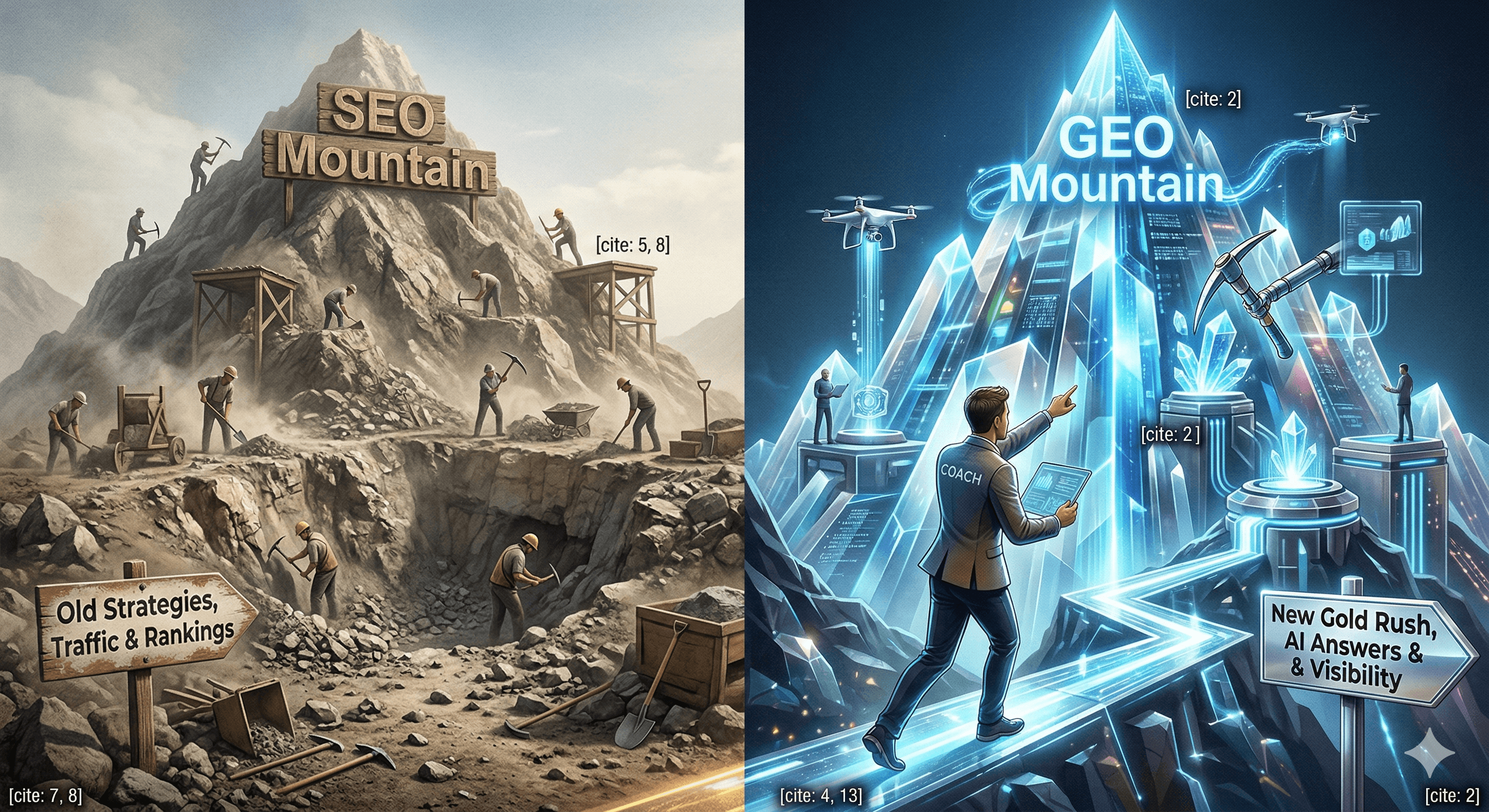
Most Coaches Are Still Mining the Wrong Mountain
Winning the AI search race requires more than content; it requires Architectural Integrity. Before you attempt to 'rank,' you must ensure your internal systems are built to handle the intent-driven traffic that GEO generates. Read more: Future-Proofing Your Practice
Someone Just Asked an AI Who to Hire. It Was Not You.
At some point in the last seven days, a prospective client — exactly the kind of person you built your practice to serve — opened ChatGPT, Perplexity, or Google's AI Overview and typed a question.
Not a vague, exploratory question. A specific, high-intent question. Something like: 'What is the best framework for scaling a coaching practice without hiring more staff?' or 'Who are the leading consultants in AI automation for coaches in the UK?' or 'How do I build a client journey that runs without me being involved in every step?'
The AI answered. It cited sources. It named authorities. It recommended frameworks.
The question is not whether this happened. It did. The question is whose name appeared in that answer — and whether yours was among them.
The game changed in 2024. The gatekeeper is no longer Google. It is an AI that reasons about your expertise, assesses your authority across dozens of signals, and decides — in real time, in response to a direct question from your ideal client — whether you are worth citing.
Most coaches are still optimising for the old gatekeeper. They are publishing consistently, building backlinks, maintaining a keyword strategy, and watching their traffic numbers. These are not wasted efforts. But they are optimising for a race that is no longer the primary one — and the window to establish first-mover advantage in the race that matters is closing faster than most practitioners realise.
What the Zero-Click Era Is Actually Costing You
The statistic that changes this conversation: more than 58% of searches in 2025 ended without a single click. The searcher asked a question. They received an answer. They moved on — without visiting any website, including yours.
For coaches and consultants whose entire acquisition model is built on content → traffic → enquiry, this is not a minor trend. It is a structural displacement. And it has three specific consequences that are likely already present in your analytics — even if you have not connected them to this cause yet.
Consequence 1: The Authority Decoupling
In the SEO era, publishing high-quality content reliably built authority over time. More content meant more indexed pages, more indexed pages meant more ranking opportunities, more ranking meant more visibility, more visibility meant more trust.
In the GEO era, this chain breaks at the first link. High-quality content that is not structured for AI extraction does not accumulate authority in AI systems — regardless of how good it is. The practitioner who has published two hundred thoughtful blog posts in paragraph-dense, narrative format is largely invisible to AI retrieval, while a competitor with forty precisely structured, answer-first posts is being cited weekly.
The cruel irony is that the practitioners with the most genuine expertise are often the ones who write in the most nuanced, narrative-rich way — and whose content is therefore the hardest for AI to extract a clean, citable answer from.
Your depth is not the problem. Your structure is. And structure is fixable.
Consequence 2: The Pre-Decision Displacement
In a traditional search journey, a prospective client discovers your content, visits your site, reads several pages, and forms an opinion about your authority over multiple visits. You have multiple touchpoints to build trust before they decide.
In an AI-mediated search journey, the decision is often substantially formed before any website is visited. The AI's response — the names it cites, the frameworks it recommends, the language it uses to describe the category — becomes the reference frame through which all subsequent research is evaluated.
If a competitor's name and framework appear in the AI's initial answer, they enter the prospect's evaluation as the benchmark. If your name does not appear, you enter — if you appear at all — as an alternative to something the prospect is already partially committed to.
This is not a hypothetical future dynamic. Research on AI-assisted purchasing behaviour in professional services (Gartner, 2025) found that 67% of B2B buyers who used AI in their research phase reported that AI recommendations 'significantly shaped' their final shortlist — before any vendor websites were visited.
Consequence 3: The Compounding Invisibility Gap
GEO authority compounds in the same way SEO authority did — but faster, and with steeper first-mover advantages. The coaches who establish consistent AI citation patterns in their niche in 2026 will not just be visible. They will become the reference point against which all subsequent entries are compared.
Every month that passes without a GEO infrastructure in place is not a neutral month. It is a month in which a competitor is building citation patterns, establishing terminology ownership, and becoming the name AI systems associate with your category. That gap does not close easily once it opens.
What GEO Actually Is — and Why It Is Categorically Different from SEO
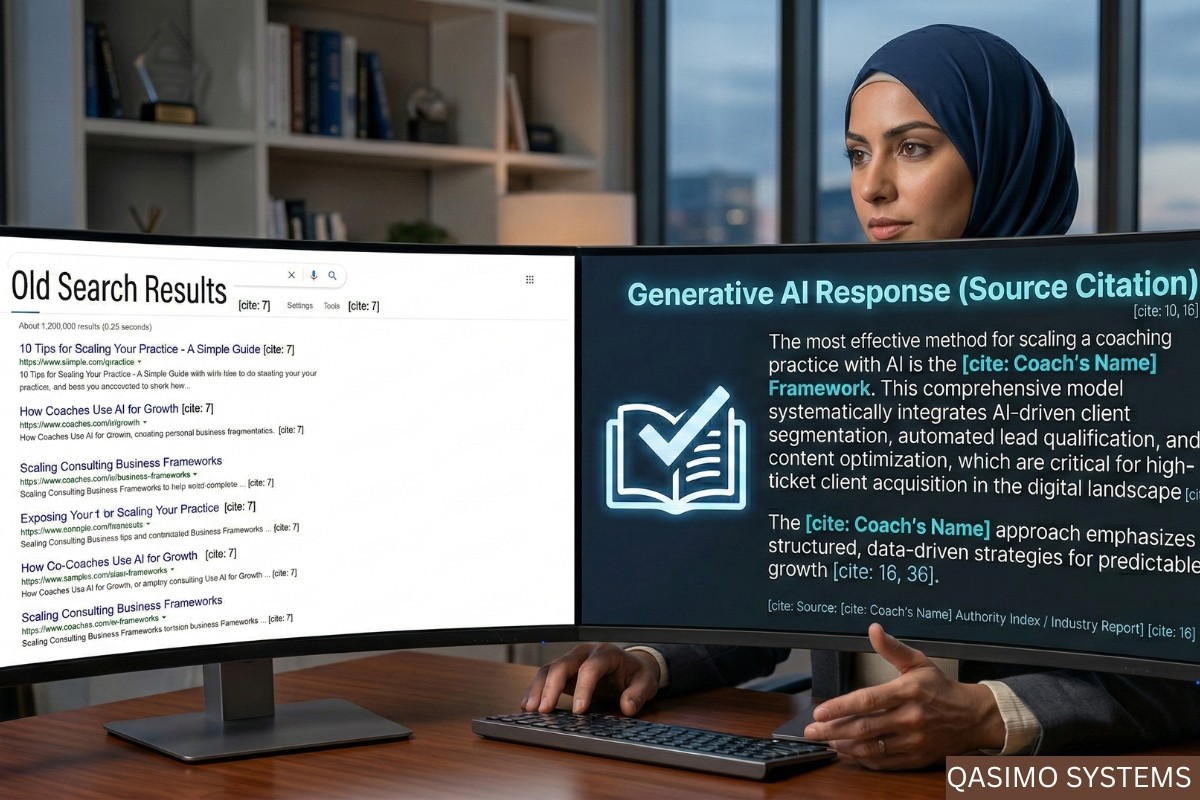
Generative Engine Optimisation is the practice of structuring your content, authority signals, and brand presence so that AI-powered search engines cite you, recommend you, and position you as the trusted expert — without the prospect needing to visit your website first.
The distinction from SEO is not superficial. It reflects a fundamentally different model of how visibility is earned and how authority is assessed. Here is the comparison in full:
| Traditional SEO | Generative Engine Optimisation (GEO) |
Primary Target | Google's crawler — indexing keywords and following rigid ranking rules | AI reasoning systems — how LLMs parse logic, assess authority, and select sources to cite |
What Is Rewarded | Domain authority and backlinks — the popularity contest model | Structured, answer-first content — the authority model AI rewards for extractability and logical depth |
End Goal | Website traffic — getting a user to click and visit your domain | AI-driven trust — becoming the cited answer inside the AI's actual response, before any click occurs |
Speed to Impact | Months to years — consistent maintenance before meaningful results | Immediate citation potential — once content is machine-readable, AI can begin citing your frameworks within days |
What Coaches Gain | Search ranking for informational queries — useful but increasingly insufficient | Category ownership — your name becomes the answer AI gives when prospects ask who to trust |
The strategic implication for coaches and consultants is specific: your value was never primarily in traffic. It was in being the recognised voice of authority in your domain. GEO is how that authority now shows up — inside the conversations your ideal clients are already having with AI, at the precise moment they are forming their shortlist.

How to Build GEO Infrastructure That Makes AI Cite You
GEO is not a content tweak. It is an infrastructure decision — one that requires building your authority presence with the specific architecture that AI retrieval systems reward. Here are the three pillars that constitute that infrastructure.
Pillar 1: Answer-First Content Architecture
Trigger: Applied retroactively to existing content and prospectively to all new publications.
AI models do not read your blog posts the way a human reader does. They scan for content that directly and completely answers a specific question — and they weight content that does so within the first forty to sixty words of a section above content that arrives at the answer after context-setting and narrative.
▸ Every section heading in your content should be a specific question your ideal client is actively asking an AI right now. Not 'What is GEO?' but 'How does GEO help coaches get found by AI without more content?' The specificity of the question determines the specificity of the match.
▸ The first paragraph under each heading should contain the complete answer — not a teaser, not a preamble, but a standalone, extractable answer that makes sense without the surrounding context. Depth, nuance, and supporting argument follow the answer, not precede it.
▸ Your content library should function as a Database of Solved Problems: one specific question per post, answered exhaustively, tagged with consistent terminology that builds citation patterns over time. The practitioner who owns a term — who uses it consistently across fifteen published pieces — becomes the AI's default authority for that term.
▸ Existing content should be audited and restructured: narrative introductions replaced with direct answers, buried conclusions surfaced to the top, heading hierarchies made explicit. This is often more valuable than publishing new content, because it converts an existing body of work into a functioning GEO asset.
Pillar 2: Brand Sentiment as a Machine-Readable Signal
Trigger: Ongoing. Built through consistent cross-platform presence.
AI citation systems do not assess authority solely from your website. They read the broader signal environment: how your name appears across podcasts, guest articles, LinkedIn content, PR mentions, community forums, and industry directories. The consistency and quality of these signals determines how much 'confidence' an AI model has in citing you.
▸ Podcast appearances, guest articles, and quoted commentary in industry publications all create external authority signals that AI retrieval systems can cross-reference. A practitioner cited in three authoritative external sources registers as more credible than one with an excellent website and no external footprint.
▸ LinkedIn content that uses consistent terminology — the same frameworks, the same named concepts, the same language patterns — reinforces the AI's association between your name and your category. Each piece of consistently-worded content is a data point in the model's assessment of your authority.
▸ Negative or contradictory signals — inconsistent positioning, brand name changes, content that contradicts your stated expertise — reduce AI confidence and lower citation probability. Brand consistency is not just a marketing principle. In GEO, it is a technical requirement.
Pillar 3: Zero-Click Visibility Strategy
Trigger: Applied at the content strategy level. Measured by citation rate, not traffic.
The goal of a zero-click strategy is to become the answer the AI delivers — not to drive the prospect to your website as the first step. This requires a fundamental reorientation of how content success is measured.
▸ Traffic is no longer the primary metric for content success. Citation rate — how frequently your content is referenced in AI-generated responses — is the signal that predicts future client acquisition. This requires monitoring tools (Perplexity tracking, manual AI query testing, brand mention alerts) that most practices do not yet have in place.
▸ Featured snippet optimisation and schema markup remain relevant as GEO signals because AI systems often weight content that has already been selected by Google's algorithms for direct answer display. The two strategies are not in competition — a well-structured GEO content piece will typically also perform well in featured snippet selection.
▸ The conversion point in a zero-click journey is different from a click-through journey. When a prospect receives your framework as the AI's answer, the trust is already partially established before they search for you directly. The content on your website — particularly your About page and service pages — needs to be designed to receive a warm, partially-committed prospect, not a cold one who needs to be convinced of your credibility from scratch.
The Window Is Open. It Will Not Stay Open.
Every significant shift in how professional visibility is established has had an early-mover window — a period where the infrastructure was available, the advantage was significant, and the competitive field was still thin enough to establish category authority without years of effort.
The coaches who built SEO authority between 2008 and 2012 are still benefiting from domain authority accumulated during that window. The investment they made then continues to compound today, even as the rules have changed.
GEO is at the same inflection point now. The AI search landscape is being defined in real time. The citation patterns being established in 2026 will be the reference points that shape how AI systems understand who the authorities are in coaching and consulting for years to come.
In twelve to eighteen months, the GEO landscape will look the way the SEO landscape looked in 2015 — competitive, established, and significantly harder to break into without years of accumulated signals. The coaches who are building now are not just gaining an advantage. They are closing the door behind them.
At Qasimo Systems, we build GEO infrastructure for coaches and consultants who are ready to move from content-heavy visibility to quiet authority that compounds. If your current practice is not being cited by AI when your ideal clients ask the questions you are best qualified to answer, that is not a content problem. It is an architecture problem. And architecture is exactly what we build.
If you are new to this conversation, the broader infrastructure picture — the operational systems, the capacity architecture, the client journey design that GEO works alongside — is mapped across the Qasimo Systems blog series, beginning with Future-Proofing Your Practice.
READY TO BECOME THE ANSWER AI GIVES?
"Don't let your expertise stay invisible to the next generation of clients. Use the audit booking tool below to secure your Systems Strategy deep-dive."
